
The Apache AH Mk.1 was derived from the Boeing AH-64D Apache and was built under licence by Westland Helicopters (later AgustaWestland). Sixty-seven Apache AH Mk.1s were ordered for the British Army, the first eight of which were made by Boeing. The aircraft came into service with the Army Air Corps (AAC) in 2001, becoming the first purpose-built attack helicopter to be adopted by the British Army.
Unlike its predecessor, the British Apache was powered by two Rolls-Royce Turbomeca RTM 322 engines. Each engine could deliver up to 2,300 shaft horsepower, giving the aircraft a cruising speed of around 260 kilometres per hour. The British helicopter was also fitted with folding main rotor blades so it could operate from ships.
The Apache AH Mk.1 was fitted with a 30-mm M230 chain gun which could fire about 625 rounds per minute. It could also carry up to 76 CRV-7 rockets or up to 16 Hellfire missiles, or a combination of these weapons, depending on the requirements of a mission. The Longbow radar located above the main rotor head could track targets, monitor airspace, and profile the surrounding terrain, providing vital information for the aircrew.
The Army Air Corps deployed Apache AH Mk.1s in Afghanistan and during the NATO military intervention in Libya in 2011. It has now been replaced by the Apache AH-64E model.
Apache AH Mk.1 ZJ224
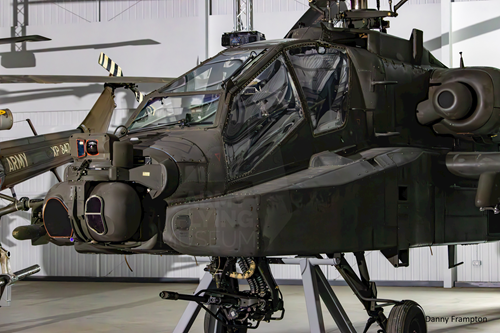
ZJ224 on display in the Museum.
Apache AH Mk.1 ZJ224 entered service with 656 Squadron AAC on 18 August 2003. During its service life the helicopter flew in Afghanistan, Norway, Estonia, and Oman and was used for trials on the aircraft carrier HMS Queen Elizabeth.
Operation GLACIER
On 15 January 2007, Zulu Company of 45 Commando Royal Marines (RM) launched an attack on Jugroom Fort, a Taliban stronghold in Helmand Province. The assault was called off when the unit came under heavy fire and suffered casualties. After withdrawing it became clear that one of their number, Lance Corporal Mathew Ford RM, was missing.
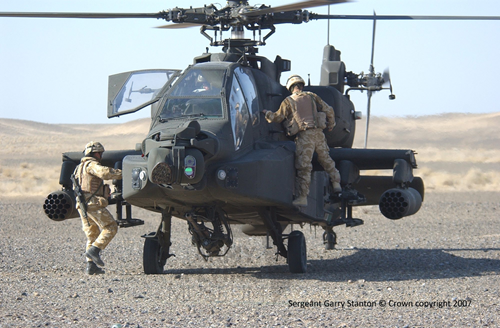
Captain David Rigg RE (left) and Marine Chris Fraser-Perry RM climb aboard ZJ224.
A rescue mission was planned that involved two Apache helicopters landing in the fort, carrying Commandos on the outside of the aircraft. Staff Sergeant Carl Bird AAC and Warrant Officer Ed Macy AAC flew ZJ224 on this mission, carrying Captain Dave Rigg of the Royal Engineers and Marine Chris Fraser-Perry.
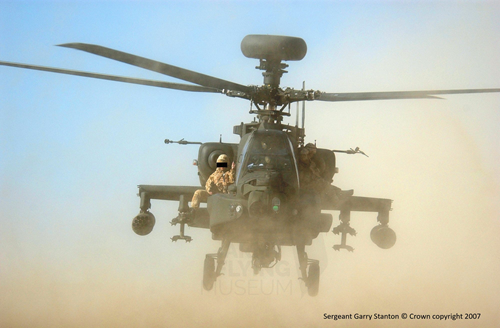
The helicopter takes off for the rescue mission.
On landing in the fort, the Apaches were surrounded by thick dust and were subjected to intense enemy fire. At one point, Warrant Officer Macy left the helicopter to assist with the retrieval of Lance Corporal Ford who was secured to ZJ224. After about five minutes on the ground the helicopters lifted off.
On arrival in a safe area, it became clear that tragically Lance Corporal Ford had been fatally wounded during the initial assault on the fort.
Captain Rigg and Warrant Officer Macy of ZJ224 were awarded Military Crosses for the mission. For the other Apache that landed in the fort, Warrant Officer O’Malley AAC was awarded a Distinguished Flying Cross and Staff Sergeant Armatage AAC received a Military Cross.
ZJ224 was formally gifted to the Museum by the Ministry of Defence and unveiled by His Majesty King Charles III on 13 May 2024.
The installation of the Apache in the Museum.
The Museum received huge support and assistance with the gifting and installation of the aircraft and would like to thank all those who were involved.